there's a lot of digital ink getting spilled right now over symantec's brian dye saying that anti-virus is dead (one, two, three, four, five, and more to come i'm sure), but i don't see many people asking the tough question, which is "why should we believe symantec now"?
looking back over my past posts about symantec paints a pretty unappealing picture, and reveals what might be considered a pattern. virtually right from the beginning they named their consumer anti-virus product after a man who famously said computer viruses were an urban legend. then, when they then tried to reinvent themselves with their "security 2.0" campaign, they claimed the virus problem was solved. now, when it appears they're trying to reinvent themselves again, they're saying that anti-virus is dead. it seems that whenever their business plan calls for serious marketing, they latch on to messages that grab attention but whose reality is questionable at best.
when the biggest anti-virus vendor starts saying anti-virus is dead, there's no way that isn't going to grab a lot of attention. it seems designed to hurt the very industry they're on top of, while they are (apparently) in the process of trying to distance themselves from it. i've noted in the past that the biggest players in the industry are hurt the least by the consequences of their bad acts. as market leaders they control perception not just of themselves but of the entire industry, so that even if a smaller player wanted to try to present a more reasonable and accurate view of things in order to better compete on technical merit rather than deceptive marketing manipulation, there's very little impact they could have. saying that anti-virus is dead while simultaneously trying to position themselves as something else is essentially a scorched earth tactic.it will hurt the entire anti-virus industry while drawing attention to the alternate industry they're trying to create/break into.
when the biggest anti-virus vendor starts saying anti-virus is dead, there's also no way that shouldn't raise the hairs on the back of your neck. out of the blue symantec starts mimicking exactly the same message that enterprise level infosec people have been saying for years? am i the only one who thinks that sounds like it belongs in the too good to be true category? this is the same kind of technique a malware writer might use to trick you into trying out his/her handiwork. before you get any ideas about symantec using 'trojan marketing', though, it's also the same kind of technique AV marketers used when they told people just using AV would solve their security problems. too good to be true has been part of the AV marketing arsenal from the very beginning, it's just that this new one about AV being dead seems to be designed for a much more select class of dupe, i mean user. this is the same shit, it's just a different pile.
it'll probably work, though. telling people what they want to hear is unfortunately quite effective. even smart people will fall for it, because despite being smart, those people still want to hear something that is far too simplistic to have anything in common with reality. when you look closely enough, the truth always seems to wind up being messy and complicated, not something that could fit in a sound-bite.
this is the reason why i try to convince people to stop listening to marketing (and really, everything that comes out of a vendor is marketing to some degree). this is almost certainly nothing more than another in a long line of efforts to deceive and manipulate the market. if you must listen to something, listen to their actions. they aren't retiring their AV product, so how dead can AV really be?
all that being said, i actually do welcome their shift in focus from purely prevention to now include more detection and recovery. it's about time AV vendors started getting serious about the last 2 parts of the PDR triad (prevention, detection, recovery). it doesn't have to be purely service-based detection though. years ago we had generic detection tools (such as integrity checkers) that end users could use themselves. symantec's focus on providing detection services instead of detection tools belies a philosophy of not trusting the users' competence, which in turn is consistent with their long history of failing to educate, elevate, and empower their users. maybe that kind of paternalism is appropriate for home users, but enterprise security operations? i thought we could expect enterprise level IT and infosec professionals to develop skills and expertise in these kinds of areas, so why is symantec choosing a path that takes these things out of advanced customers' hands?
as much as it seems like symantec is doing an about-face, they really haven't changed their tune. telling enterprises what they want to hear is just a ploy so that enterprises will get in bed with them (that's just what we call pillow talk, baby). they still aren't giving their users any new power to affect their own security outcomes. so far they're just offering words. nothing but sweet, sweet words that turn into bitter orange wax in your ears.
Showing posts with label symantec. Show all posts
Showing posts with label symantec. Show all posts
Tuesday, May 06, 2014

Sunday, February 20, 2011
ethical conflict in the anti-malware domain
forgive my silence over the last little while. motivation to blog sometimes isn't easy to find. as time wears on, fewer and fewer things get under my skin enough to drive me to rant (is that what it means to mellow with age?). but since you're reading this i think you can guess what this post infers.
five years ago i wrote a post about what i perceived as an ethical conflict in the anti-'rootkit' domain. it detailed the actions of two of the most notorious names in stealthkit research, jamie butler and greg hoglund, and how they were profiting from making a particular niche of the malware problem more popular (and thus, inevitably a bigger problem).
one of the things i pointed out was that symantec was working with a start-up company (komoku) that had jamie butler (author of what was at one time one of the most widely deployed stealthkits around) as it's chief technology officer. i thought the fact that an anti-malware company was in bed with a company that hired such a high profile malware writer deserved at least a moment of reflection, considering the hard-line stance anti-malware companies take on hiring malware writers themselves. at the end of the day, mind you, that start-up was focused on prevention so maybe the argument could be made that mr. butler had or was trying to reform in some way. (mr. butler has since moved on to mandiant, along with his disciple {the FU2 to butler's FU} peter silberman)
when i read earlier this past week that another anti-malware company (mcafee) had been working with greg hoglund's company (hbgary) i thought it an interesting historical footnote but paid little attention to it beyond that (though, if i had remembered that mcafee had once been pointing fingers at rootkitDOTcom, maybe the hypocrisy would have stood out more). after all, little attention seemed to be paid to such connections five years ago so why should this time be any different? well, that was before i knew what hbgary was in to.
apparently, on top of the legitimate work that one can find out about by visiting the hbgary website (which of course i won't link to), it appears that hbgary also writes and sells malware for fairly large sums of money. the customers for their malware include the government/military but might not stop there. even if that set of customers does stop there, hbgary appears to be in the high-end commercial malware business.
so where does that leave mcafee? it leaves them in bed with commercial malware writers. while AV companies have been proclaiming for decades that they don't and won't hire malware writers, apparently they don't have to. they can simply partner with the boutique security shops that do. clearly they are not picking their business associates as carefully as they are their actual employees.
and then there's the claim that surfaces from time to time that AV companies won't make special provisions to keep malware deployed by the authorities from getting detected. what's the point of making such a claim if you're just going to turn around and do business with the company that may very well be making said malware?
how many other AV companies, besides mcafee, were or are in bed with hbgary? how many are in bed with companies LIKE hbgary? where's their ethical high horse when it comes to partnerships? why wasn't the "malware writers need not apply" policy updated when commercial malware became the norm and presented the loophole we see before us today?
some AV companies are rewarding malware writers financially. it may not be in the ways we traditionally thought of, but with the #2 company in the industry involved in this practice (and arguably the #1 company as well, depending on where you want to draw the line), the end result is AV companies contributing to the commercial success of malware writers, and that is not ok at all.
five years ago i wrote a post about what i perceived as an ethical conflict in the anti-'rootkit' domain. it detailed the actions of two of the most notorious names in stealthkit research, jamie butler and greg hoglund, and how they were profiting from making a particular niche of the malware problem more popular (and thus, inevitably a bigger problem).
one of the things i pointed out was that symantec was working with a start-up company (komoku) that had jamie butler (author of what was at one time one of the most widely deployed stealthkits around) as it's chief technology officer. i thought the fact that an anti-malware company was in bed with a company that hired such a high profile malware writer deserved at least a moment of reflection, considering the hard-line stance anti-malware companies take on hiring malware writers themselves. at the end of the day, mind you, that start-up was focused on prevention so maybe the argument could be made that mr. butler had or was trying to reform in some way. (mr. butler has since moved on to mandiant, along with his disciple {the FU2 to butler's FU} peter silberman)
when i read earlier this past week that another anti-malware company (mcafee) had been working with greg hoglund's company (hbgary) i thought it an interesting historical footnote but paid little attention to it beyond that (though, if i had remembered that mcafee had once been pointing fingers at rootkitDOTcom, maybe the hypocrisy would have stood out more). after all, little attention seemed to be paid to such connections five years ago so why should this time be any different? well, that was before i knew what hbgary was in to.
apparently, on top of the legitimate work that one can find out about by visiting the hbgary website (which of course i won't link to), it appears that hbgary also writes and sells malware for fairly large sums of money. the customers for their malware include the government/military but might not stop there. even if that set of customers does stop there, hbgary appears to be in the high-end commercial malware business.
so where does that leave mcafee? it leaves them in bed with commercial malware writers. while AV companies have been proclaiming for decades that they don't and won't hire malware writers, apparently they don't have to. they can simply partner with the boutique security shops that do. clearly they are not picking their business associates as carefully as they are their actual employees.
and then there's the claim that surfaces from time to time that AV companies won't make special provisions to keep malware deployed by the authorities from getting detected. what's the point of making such a claim if you're just going to turn around and do business with the company that may very well be making said malware?
how many other AV companies, besides mcafee, were or are in bed with hbgary? how many are in bed with companies LIKE hbgary? where's their ethical high horse when it comes to partnerships? why wasn't the "malware writers need not apply" policy updated when commercial malware became the norm and presented the loophole we see before us today?
some AV companies are rewarding malware writers financially. it may not be in the ways we traditionally thought of, but with the #2 company in the industry involved in this practice (and arguably the #1 company as well, depending on where you want to draw the line), the end result is AV companies contributing to the commercial success of malware writers, and that is not ok at all.
Monday, January 17, 2011
how do you get to the top?
so how do you get to the top? well, if you're an anti-virus company it stands to reason you get there through technical excellence (yes, i can hear you snickering from here). of course if you have technical excellence then it also stands to reason that your people know what it is they're talking about when they go and say something about malware in public.
specifically, what i and many other people expect is that people working for the #1 anti-virus company to at the very least know the difference between viral and non-viral malware. those kinds of basics seem like they should be prerequisites for achieving technical excellence in the anti-virus industry.
apparently that is expecting too much, since some people (in the industry, no less) are still using the term 'virus' as the umbrella term instead of the more accurate term 'malware'. i'm not sure exactly when it happened, but at some point i started hearing more terminology misuse from media sources within the industry than i hear from general media sources in the world at large.
to say that cancels out any willingness i might have had to suspend disbelief about the question of technical excellence is an understatement.
now one explanation i could entertain is that this is actually part of a very clever plot to keep the public confused and disoriented. governments long ago figured out that it was easier to control their subjects if they kept them stupid and uneducated. it doesn't seem unreasonable to suppose that corporations might make use of similar tactics. the foundation upon which greater understanding and ultimately greater self-reliance is built on is an accurate and consistent body of knowledge about the topic at hand. authoritatively using terms where they don't belong unquestionably undermines the process of developing that body of knowledge. it is precisely the type of tactic i would expect if corporations were trying to keep the masses easily manipulated.
that being said, i'm still prone to give the benefit of the doubt. never attribute to malice that which can easily be explained by incompetence. of course, since that reflects poorly on the possibility of technical excellence, that still leaves open the question of how one can get to the top and stay there.
without technical excellence being the driving force to keep the top players on top, we eliminate the possibility that the system is a meritocracy - or at least if there is a meritocracy, it's not the merits of the technology that are important but rather the merits of the efforts to manipulate people into thinking their technology has the most merit. that's called marketing. in essence, it's the best manipulator, not the best technology, that wins.
(though a system that rewards manipulation seems like it should eventually evolve into one that actively tries to keep people stupid in order to manipulate them more easily)
specifically, what i and many other people expect is that people working for the #1 anti-virus company to at the very least know the difference between viral and non-viral malware. those kinds of basics seem like they should be prerequisites for achieving technical excellence in the anti-virus industry.
apparently that is expecting too much, since some people (in the industry, no less) are still using the term 'virus' as the umbrella term instead of the more accurate term 'malware'. i'm not sure exactly when it happened, but at some point i started hearing more terminology misuse from media sources within the industry than i hear from general media sources in the world at large.
to say that cancels out any willingness i might have had to suspend disbelief about the question of technical excellence is an understatement.
now one explanation i could entertain is that this is actually part of a very clever plot to keep the public confused and disoriented. governments long ago figured out that it was easier to control their subjects if they kept them stupid and uneducated. it doesn't seem unreasonable to suppose that corporations might make use of similar tactics. the foundation upon which greater understanding and ultimately greater self-reliance is built on is an accurate and consistent body of knowledge about the topic at hand. authoritatively using terms where they don't belong unquestionably undermines the process of developing that body of knowledge. it is precisely the type of tactic i would expect if corporations were trying to keep the masses easily manipulated.
that being said, i'm still prone to give the benefit of the doubt. never attribute to malice that which can easily be explained by incompetence. of course, since that reflects poorly on the possibility of technical excellence, that still leaves open the question of how one can get to the top and stay there.
without technical excellence being the driving force to keep the top players on top, we eliminate the possibility that the system is a meritocracy - or at least if there is a meritocracy, it's not the merits of the technology that are important but rather the merits of the efforts to manipulate people into thinking their technology has the most merit. that's called marketing. in essence, it's the best manipulator, not the best technology, that wins.
(though a system that rewards manipulation seems like it should eventually evolve into one that actively tries to keep people stupid in order to manipulate them more easily)
Monday, August 09, 2010
numbers, context, and background
one of the things i've come across while reading various sources is an attempt to pin down an intended target nation for the stuxnet worm based on prevalence data. the theory goes something like 'since nation X is where most instances of stuxnet are found, therefore nation X was the intended target (because obviously more work was put into spreading it there)'.
this theory has some problems, however. first and foremost is that not all the numbers agree. while we have symantec saying that ~60% is in Iran, we also have eset saying that ~60 are in the US just 3 days earlier. they can't both be right - or can they? and if they are, what are the implications for the targeted nation theory?
as is always the case when there are contradictory numbers, we have to look at how those numbers were arrived at. in fact, even when there aren't contradictory numbers, we should still be paying close attention to how those numbers were arrived at.
close examination of vikram thakur's post on the symantec site suggests that there number represents actual infected machines trying to connect to their C&C server (on top of everything else, stuxnet is also a botnet) during a 3 day period between july 19 and july 22. they were able to gather this data because they redirected the domains hosting the C&C servers to themselves so it seems like it would be a pretty accurate snapshot of the pool of infected machines at a particular point in time.
eset's numbers in david harley's post came from their installed clients throughout the world. their cloud-based technology reported the instances - however, since stuxnet employs stealth it's more likely that rather than reporting infected machines (where it would be active and hidden) it's actually reporting infected USB drives. it could also be reporting both if eset's products can see through the stealth, but the key point is that eset's numbers almost certainly include infected USB drives while symantec's do not. the USB numbers are important because that's how this worm spreads and if one were going to work on targeting a particular nation, spreading infected USB drives in that nation would be the way to do it.
furthermore eset's numbers appear to be from the time detection for the worm was added until the time the statistic was reported, rather than just the 3 day period covered by symatec's figures. this means that eset's figures represent a measurement of how many instances of the worm there were over it's detected lifetime to that point, while symantec's figures represent a measurement of how many infected machines remained at that point. this is important because by the time symatec started collecting it's data, negative population controls had already been in effect for some time.
controls which, like worms they intend to control, are not necessarily uniformly effective across the entire globe. some products have greater market share in some regions that they do in others, and the dominant product in certain regions might be poor at controlling particular worms and thus allow those worms greater reproductive advantages in those regions than they might find in others. the presence of population controls like anti-malware software affects both the death and birth rates of worm instances and as anyone who's heard johnny long discuss hackers for charity knows, such controls are not uniformly present or effective across all regions.
there are a actually a variety of other factors, in addition to such controls, that contribute to how well and in what way a worm or virus spreads, as discussed in some detail by jeff kephart, david chess, and steve white in "Computers and Epidemiology". some of these factors, like the degree of connectedness of susceptible hosts (and how often adequate contact between such hosts happens), can be influenced by computing culture, which in turn can be influenced by culture in the more general sense, geopolitical climate, and even socioeconomic considerations. hypothetically speaking, a nation that is cut off from US technologies due to trade sanctions (as metioned by by brian krebs) could well exhibit a higher rate of software sharing as part of 'alternative' procurement techniques and in so doing raise the region above the epidemic threshold for some unspecified worm.
ultimately both symantec and eset could be right since they were measuring different things over different periods of time. what that means for the targeted nation theory is that things aren't as clear-cut as either set of numbers would suggest on their own. what we do know is that stuxnet appeared to enjoy more reproductive success in Iran than elsewhere. whether that's down to purely epidemiological factors or intentional injection of the worm into the local computing population by a malicious actor is unclear, but eset's data would support an argument against the latter option as the effort seems to have been expended elsewhere. on the other hand, if we were to entertain the notion that the US was the target based on the amount of infected materials floating around the computing population, then we are left once again with the conclusion that stuxnet was a failure since in spite of all that effort the prevalence of actual infected machines in the US was minuscule.
i don't think much can be read into the fact that there were more infected machines in Iran than elsewhere since such pockets of infection are actually normal - especially for self-replicating malware that must be spread by physical media. some region had to draw the short straw and this time it was Iran.
this theory has some problems, however. first and foremost is that not all the numbers agree. while we have symantec saying that ~60% is in Iran, we also have eset saying that ~60 are in the US just 3 days earlier. they can't both be right - or can they? and if they are, what are the implications for the targeted nation theory?
as is always the case when there are contradictory numbers, we have to look at how those numbers were arrived at. in fact, even when there aren't contradictory numbers, we should still be paying close attention to how those numbers were arrived at.
close examination of vikram thakur's post on the symantec site suggests that there number represents actual infected machines trying to connect to their C&C server (on top of everything else, stuxnet is also a botnet) during a 3 day period between july 19 and july 22. they were able to gather this data because they redirected the domains hosting the C&C servers to themselves so it seems like it would be a pretty accurate snapshot of the pool of infected machines at a particular point in time.
eset's numbers in david harley's post came from their installed clients throughout the world. their cloud-based technology reported the instances - however, since stuxnet employs stealth it's more likely that rather than reporting infected machines (where it would be active and hidden) it's actually reporting infected USB drives. it could also be reporting both if eset's products can see through the stealth, but the key point is that eset's numbers almost certainly include infected USB drives while symantec's do not. the USB numbers are important because that's how this worm spreads and if one were going to work on targeting a particular nation, spreading infected USB drives in that nation would be the way to do it.
furthermore eset's numbers appear to be from the time detection for the worm was added until the time the statistic was reported, rather than just the 3 day period covered by symatec's figures. this means that eset's figures represent a measurement of how many instances of the worm there were over it's detected lifetime to that point, while symantec's figures represent a measurement of how many infected machines remained at that point. this is important because by the time symatec started collecting it's data, negative population controls had already been in effect for some time.
controls which, like worms they intend to control, are not necessarily uniformly effective across the entire globe. some products have greater market share in some regions that they do in others, and the dominant product in certain regions might be poor at controlling particular worms and thus allow those worms greater reproductive advantages in those regions than they might find in others. the presence of population controls like anti-malware software affects both the death and birth rates of worm instances and as anyone who's heard johnny long discuss hackers for charity knows, such controls are not uniformly present or effective across all regions.
there are a actually a variety of other factors, in addition to such controls, that contribute to how well and in what way a worm or virus spreads, as discussed in some detail by jeff kephart, david chess, and steve white in "Computers and Epidemiology". some of these factors, like the degree of connectedness of susceptible hosts (and how often adequate contact between such hosts happens), can be influenced by computing culture, which in turn can be influenced by culture in the more general sense, geopolitical climate, and even socioeconomic considerations. hypothetically speaking, a nation that is cut off from US technologies due to trade sanctions (as metioned by by brian krebs) could well exhibit a higher rate of software sharing as part of 'alternative' procurement techniques and in so doing raise the region above the epidemic threshold for some unspecified worm.
ultimately both symantec and eset could be right since they were measuring different things over different periods of time. what that means for the targeted nation theory is that things aren't as clear-cut as either set of numbers would suggest on their own. what we do know is that stuxnet appeared to enjoy more reproductive success in Iran than elsewhere. whether that's down to purely epidemiological factors or intentional injection of the worm into the local computing population by a malicious actor is unclear, but eset's data would support an argument against the latter option as the effort seems to have been expended elsewhere. on the other hand, if we were to entertain the notion that the US was the target based on the amount of infected materials floating around the computing population, then we are left once again with the conclusion that stuxnet was a failure since in spite of all that effort the prevalence of actual infected machines in the US was minuscule.
i don't think much can be read into the fact that there were more infected machines in Iran than elsewhere since such pockets of infection are actually normal - especially for self-replicating malware that must be spread by physical media. some region had to draw the short straw and this time it was Iran.
Thursday, October 02, 2008
symantec's reputation is in the clouds
the folks at symantec posted something interesting today - It's All About Reputation...
well, they're not the first ones to go into the cloud (obviously, see panda, trend, mcafee, etc)... nor are they the first to go with a reputation system (drive sentry, for starters)... are they the first to put a reputation system in the cloud? i don't know, maybe, but at this point it still doesn't seem like such a big deal...
what gets me, though, is the idea that it's no longer using fingerprints... a reputation system that says X is good, Y is bad, and Z is unknown is basically just a combination of a blacklist and a whitelist - and it's not a bad idea, i've been saying they complement each other well for quite a while now so actually putting both paradigms into a single product makes a lot of sense... the blacklist is what says Y is bad, the whitelist is what says X is good, and since Z isn't on either list it gets called unknown... the thing is blacklists use signatures (fingerprints) and in their own way whitelists do to - they have to in order to make sure the thing you're looking at really is the same thing you saw before and determined to be good/bad... it can't work without a signature/fingerprint/whatever... this new reputation system may use a different form of signatures, but it definitely uses them...
and as for how this protects you from brand new threats as the post suggests, i can only imagine it works like this: things on the blacklist are stopped from executing automatically, things on the whitelist are allowed to execute transparently, and things that aren't on either list will cause the user to be given an "are you sure?" prompt... finally, someone's putting dr. solly's perfect.bat (which asked the user if the file being scanned was a virus or not) to good use...
the other way it might work is that the unknowns get automatically run in a sandbox of some sort... not a sandbox meant for malware classification, mind you (a number of products already do that), but a sandbox intended to separate the handling of untrusted items from the trusted host system... i mean, since they're already adding 2 of the 3 preventative paradigms into a single product (hopefully seamlessly), wouldn't it be cool if they added the 3rd as well? i won't hold my breath for them actually implementing this, though...
well, they're not the first ones to go into the cloud (obviously, see panda, trend, mcafee, etc)... nor are they the first to go with a reputation system (drive sentry, for starters)... are they the first to put a reputation system in the cloud? i don't know, maybe, but at this point it still doesn't seem like such a big deal...
what gets me, though, is the idea that it's no longer using fingerprints... a reputation system that says X is good, Y is bad, and Z is unknown is basically just a combination of a blacklist and a whitelist - and it's not a bad idea, i've been saying they complement each other well for quite a while now so actually putting both paradigms into a single product makes a lot of sense... the blacklist is what says Y is bad, the whitelist is what says X is good, and since Z isn't on either list it gets called unknown... the thing is blacklists use signatures (fingerprints) and in their own way whitelists do to - they have to in order to make sure the thing you're looking at really is the same thing you saw before and determined to be good/bad... it can't work without a signature/fingerprint/whatever... this new reputation system may use a different form of signatures, but it definitely uses them...
and as for how this protects you from brand new threats as the post suggests, i can only imagine it works like this: things on the blacklist are stopped from executing automatically, things on the whitelist are allowed to execute transparently, and things that aren't on either list will cause the user to be given an "are you sure?" prompt... finally, someone's putting dr. solly's perfect.bat (which asked the user if the file being scanned was a virus or not) to good use...
the other way it might work is that the unknowns get automatically run in a sandbox of some sort... not a sandbox meant for malware classification, mind you (a number of products already do that), but a sandbox intended to separate the handling of untrusted items from the trusted host system... i mean, since they're already adding 2 of the 3 preventative paradigms into a single product (hopefully seamlessly), wouldn't it be cool if they added the 3rd as well? i won't hold my breath for them actually implementing this, though...
Saturday, September 27, 2008
from the 'what were they thinking?' file
using the (incredible?) hulk as an av spokesperson:
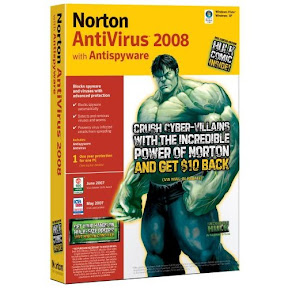
i actually saw a very small version of this in a print ad some time ago and i thought it was hilarious at the time but i couldn't find it anywhere online so that i could share it... graham just reminded me of it and better still pointed to a site where one might find it and low and behold here it is...
and why did i think it was hilarious? well, the hulk is certainly powerful, no one can deny that, but the hulk also has one major weakness - he's a dumbass... and that's who symantec chose to represent their product... well i guess it's better than a picture of peter norton who once famously said that computer viruses were an urban legend like alligators in the sewers of new york... yes, that's right, the same peter norton that norton anti-virus is named after...
i actually saw a very small version of this in a print ad some time ago and i thought it was hilarious at the time but i couldn't find it anywhere online so that i could share it... graham just reminded me of it and better still pointed to a site where one might find it and low and behold here it is...
and why did i think it was hilarious? well, the hulk is certainly powerful, no one can deny that, but the hulk also has one major weakness - he's a dumbass... and that's who symantec chose to represent their product... well i guess it's better than a picture of peter norton who once famously said that computer viruses were an urban legend like alligators in the sewers of new york... yes, that's right, the same peter norton that norton anti-virus is named after...
av product removal tools
i saw this article on ghacks.net about the McAfee Consumer Product Removal Tool and it reminded me of that xkcd cartoon that i wrote about not too long ago...
on the subject of doing your job horribly wrong, i think we can all agree that both symantec and mcafee are doing their job of providing quality anti-malware software horribly wrong when you consider they make removal tools to get rid of their own products...
it has to be considered an ignominious distinction when you have to do for your own anti-malware product what you've previously done for particularly nasty bits of malware - write dedicated removal tools and manual removal instructions...
worse still when those methods don't work... some of the IT guys at work not too long ago spent nearly a full day all told trying to remove an older version of symantec's product from my work machine (in order to put on the new symantec endpoint protection product) with no luck... the removal tools didn't help - the manual instructions might have if there'd been time left to try them on the first day... thankfully when our head of IT took a look at it on the second day, he had better luck...
on the subject of doing your job horribly wrong, i think we can all agree that both symantec and mcafee are doing their job of providing quality anti-malware software horribly wrong when you consider they make removal tools to get rid of their own products...
it has to be considered an ignominious distinction when you have to do for your own anti-malware product what you've previously done for particularly nasty bits of malware - write dedicated removal tools and manual removal instructions...
worse still when those methods don't work... some of the IT guys at work not too long ago spent nearly a full day all told trying to remove an older version of symantec's product from my work machine (in order to put on the new symantec endpoint protection product) with no luck... the removal tools didn't help - the manual instructions might have if there'd been time left to try them on the first day... thankfully when our head of IT took a look at it on the second day, he had better luck...
Sunday, August 17, 2008
look who's drinking the whitelist koolaid now
from a recent blackhat-related post on symantec's blog:
the inflection point (shouldn't that really be an intersection of two curves?) will not and can not be reached... symantec is ignoring the figures provided by bit9 whose core business is application whitelists (so when they say good software is growing at a rate that is greater than what anyone says malware is growing at, despite the fact that it's in their interests to suggest the opposite, you better believe they know what the heck they're talking about)...
symantec is also ignoring the kind of basic logic i used 2 years ago when i said (without the benefit of figures) that good software outnumbers malware and grows faster than malware, and that i described in detail more recently: basically that malware writers are a small subset of the set of all programmers and there's no realistic way for a small group to outproduce a large group...
this reminds me of an earlier symantec gaffe wherein john thompson claimed the virus problem was solved... sometimes i wonder if symantec works on the philosophy of not letting the facts get in the way of good marketing...
Symantec has been stressing for quite some time that we are on the cusp of a critical inflection point where the number of unique malicious code instances is surpassing the number of legitimate code instances.
the inflection point (shouldn't that really be an intersection of two curves?) will not and can not be reached... symantec is ignoring the figures provided by bit9 whose core business is application whitelists (so when they say good software is growing at a rate that is greater than what anyone says malware is growing at, despite the fact that it's in their interests to suggest the opposite, you better believe they know what the heck they're talking about)...
symantec is also ignoring the kind of basic logic i used 2 years ago when i said (without the benefit of figures) that good software outnumbers malware and grows faster than malware, and that i described in detail more recently: basically that malware writers are a small subset of the set of all programmers and there's no realistic way for a small group to outproduce a large group...
this reminds me of an earlier symantec gaffe wherein john thompson claimed the virus problem was solved... sometimes i wonder if symantec works on the philosophy of not letting the facts get in the way of good marketing...
Tuesday, April 08, 2008
no such thing as non-executable files
i happened to notice a post by benny ketelslegers presenting a digested view of a symantec post by andrea lelli on file format vulnerabilities... i didn't give the symantec post much thought when i first encountered it, but when i read benny's post i realized that i (and perhaps many others) have been taking the issue of executable files for granted and that the word choices being made could lead to an altogether wrong concept of what a program is and by extension what sorts of things can effectively be malicious agents on a computer...
perhaps my first exposure to the idea that there are no non-executable files came when i was still a teenager learning that for every sequence of bytes there exists a turing machine for which that sequence of bytes is a virus... i didn't even really know that much about turing machines at the time (other than they were a way to model computers) but i understood what it meant - for every sequence of bytes there exists a possible computing environment where those bytes are interpretable as a self-replicating program...
it's an interesting statement, but it's awfully narrowly focused on viruses... it turns out that the focus on viruses was just because of the context... in reality, for every sequence of bytes there exists a possible computing environment where those bytes are interpretable as a program...
that probably still sounds pretty formal to the average person, but not as formal as fred cohen's reference to the generality of interpretation... the simplest way i can express this is that there is no fundamental difference between data and code, that program code basically is data but that it's data for which there happens to be some part of the computer (some other program or subsystem) that will treat it as a collection of one or more instructions... any piece of data you can imagine can potentially be interpreted (or even misinterpreted) as program code, although it may not have much meaning or do anything useful as a program...
this ability to treat arbitrary data as code is what allows us to add new, previously unimagined capabilities to our computers in the form of new software... it's what makes our general purpose computers 'general purpose', but there's still more to the story... the ability to treat a particular chunk of data as code in practice may not even be intentional, it can be an emergent property resulting from excessive complexity and/or poor implementation... this leads to what i often refer to as exotic execution and data that makes use of such a property is generally referred to as an exploit...
all this is to say that all data may also be considered by the computer to be program code under the right conditions, and determining if those conditions have or have not been met can be very hard... as such, to say something is not program code, to say that it is non-executable is an oversimplification that can (especially when uttered by authoritative sourced like symantec) promulgate an idea that there are safe, non-executable file types which in turn gives people a false sense of security when handling those types of files...
indeed, the majority of the file types referenced by the symantec post explicitly support the ability to contain code that their respective reader applications are intended to execute (whether that be javascript in pdf documents or visual basic in microsoft office documents)... the fact that those file types can also carry known exploits should have little bearing and the very fact that people need to be corrected about the safety of such files points to a more endemic false sense of security about data in general... there are in fact no safe file types and no such thing as non-executable files...
perhaps my first exposure to the idea that there are no non-executable files came when i was still a teenager learning that for every sequence of bytes there exists a turing machine for which that sequence of bytes is a virus... i didn't even really know that much about turing machines at the time (other than they were a way to model computers) but i understood what it meant - for every sequence of bytes there exists a possible computing environment where those bytes are interpretable as a self-replicating program...
it's an interesting statement, but it's awfully narrowly focused on viruses... it turns out that the focus on viruses was just because of the context... in reality, for every sequence of bytes there exists a possible computing environment where those bytes are interpretable as a program...
that probably still sounds pretty formal to the average person, but not as formal as fred cohen's reference to the generality of interpretation... the simplest way i can express this is that there is no fundamental difference between data and code, that program code basically is data but that it's data for which there happens to be some part of the computer (some other program or subsystem) that will treat it as a collection of one or more instructions... any piece of data you can imagine can potentially be interpreted (or even misinterpreted) as program code, although it may not have much meaning or do anything useful as a program...
this ability to treat arbitrary data as code is what allows us to add new, previously unimagined capabilities to our computers in the form of new software... it's what makes our general purpose computers 'general purpose', but there's still more to the story... the ability to treat a particular chunk of data as code in practice may not even be intentional, it can be an emergent property resulting from excessive complexity and/or poor implementation... this leads to what i often refer to as exotic execution and data that makes use of such a property is generally referred to as an exploit...
all this is to say that all data may also be considered by the computer to be program code under the right conditions, and determining if those conditions have or have not been met can be very hard... as such, to say something is not program code, to say that it is non-executable is an oversimplification that can (especially when uttered by authoritative sourced like symantec) promulgate an idea that there are safe, non-executable file types which in turn gives people a false sense of security when handling those types of files...
indeed, the majority of the file types referenced by the symantec post explicitly support the ability to contain code that their respective reader applications are intended to execute (whether that be javascript in pdf documents or visual basic in microsoft office documents)... the fact that those file types can also carry known exploits should have little bearing and the very fact that people need to be corrected about the safety of such files points to a more endemic false sense of security about data in general... there are in fact no safe file types and no such thing as non-executable files...
Wednesday, March 05, 2008
why anti-virus vendors are having such a hard time
ok, first of all, the fact that there are a bunch of links back to this blog has absolutely nothing to do with why i'm responding to a post about why anti-virus products are having a hard time... that said, wow, i'm glad somebody liked those posts...
the links just spelled out some backstory, as it were... the main thrust was to highlight two reasons why av products are (or at least seem to be) having a hard time...
the two reasons given are technically about why scanners specifically are becoming less effective against malware... i agree that the reasons given are contributing to problems for scanners - packers make it easy to turn a known piece of malware into an unknown piece of malware, and pre-release detection testing helps avoid releasing malware that heuristics would detect...
but both of these things (besides being outside the scope of what known-malware scanning is supposed to handle since they specifically deal with new/unknown malware) are largely out of the av vendor's control... there is something that av vendors do have control over that is contributing even more to av products seeming to have a hard time - that being a failure to adequately manage their users... they've failed to manage user understanding of threats, they've failed to manage user awareness of the tools available for mitigating the risk posed by those threats (leading to the notion that av products are just scanners - a notion that is so pervasive that most security bloggers, including the one whose article i'm responding to, give opinions and pose logical arguments based on the assumption that it's true), and ultimately (and as a result of their other failures) they've failed to manage user expectations about what those tools can do... the real reason scanners specifically are having such a hard time is that they don't get the backup they require... they were never meant to handle all malware problems (and certainly never capable of it), only known malware problems...
one of the most novel examples of this failure is the rising anti-botnet market as discussed in this eweek article on the said market... one of the first anti-botnet applications i heard about in the mainstream was the one being provided by symantec... they released it as a separate stand alone tool and though i hoped they'd see the light and integrate it into their main anti-malware offering it seems that they've decided instead to treat it as and exciting new potential revenue stream and started charging money for it (not that i think there's anything wrong with charging money for a product, but if it's product-ready then why is it separate from the rest of their anti-malware offerings? or alternatively, if they're going to offer individual tools as well as suites, why aren't there more stand-alone tools?)... this fracturing of the anti-malware market comes at the expense of being able to communicate a clear and comprehensive message to the user/customer about anti-malware security.... without anything else to tell them how anti-malware security works (and for the most part there isn't anything else that regular people would be exposed to), the way the technologies themselves are presented implicitly communicates this to the user and fracturing your own set of offerings to make some extra green is a failure to properly manage this implicit message...
the links just spelled out some backstory, as it were... the main thrust was to highlight two reasons why av products are (or at least seem to be) having a hard time...
the two reasons given are technically about why scanners specifically are becoming less effective against malware... i agree that the reasons given are contributing to problems for scanners - packers make it easy to turn a known piece of malware into an unknown piece of malware, and pre-release detection testing helps avoid releasing malware that heuristics would detect...
but both of these things (besides being outside the scope of what known-malware scanning is supposed to handle since they specifically deal with new/unknown malware) are largely out of the av vendor's control... there is something that av vendors do have control over that is contributing even more to av products seeming to have a hard time - that being a failure to adequately manage their users... they've failed to manage user understanding of threats, they've failed to manage user awareness of the tools available for mitigating the risk posed by those threats (leading to the notion that av products are just scanners - a notion that is so pervasive that most security bloggers, including the one whose article i'm responding to, give opinions and pose logical arguments based on the assumption that it's true), and ultimately (and as a result of their other failures) they've failed to manage user expectations about what those tools can do... the real reason scanners specifically are having such a hard time is that they don't get the backup they require... they were never meant to handle all malware problems (and certainly never capable of it), only known malware problems...
one of the most novel examples of this failure is the rising anti-botnet market as discussed in this eweek article on the said market... one of the first anti-botnet applications i heard about in the mainstream was the one being provided by symantec... they released it as a separate stand alone tool and though i hoped they'd see the light and integrate it into their main anti-malware offering it seems that they've decided instead to treat it as and exciting new potential revenue stream and started charging money for it (not that i think there's anything wrong with charging money for a product, but if it's product-ready then why is it separate from the rest of their anti-malware offerings? or alternatively, if they're going to offer individual tools as well as suites, why aren't there more stand-alone tools?)... this fracturing of the anti-malware market comes at the expense of being able to communicate a clear and comprehensive message to the user/customer about anti-malware security.... without anything else to tell them how anti-malware security works (and for the most part there isn't anything else that regular people would be exposed to), the way the technologies themselves are presented implicitly communicates this to the user and fracturing your own set of offerings to make some extra green is a failure to properly manage this implicit message...
Saturday, September 22, 2007
look who's talking about whitelists now
thanks to an email from james manning i got to see a company called signacert congratulating themselves for being part of the future of security technology...
you see, signacert produces what could be classified as a whitelist type of technology and symantec's canadian VP and GM, michael murphy, was quoted in the media as saying that whitelisting is the future of security technology...
now before i go further i'll make an obligatory disclaimer (because people have gotten the wrong idea in the past) that i am not anti-whitelist, i use whitelisting techniques, i think they can be a worthy addition to a security strategy, but unlike the hypesters i don't sweep their limitations under the carpet...
when a representative from a company as well known and respected as symantec says the type of technology your company happens to produce is the future of security, i suppose it's only natural to want to congratulate yourselves for being on the vanguard - but don't be so quick to pat yourselves on the back that you choose to highlight the words of someone saying foolish things as you'll only wind up looking foolish yourselves...
you see, michael murphy made a grievous error in his representation of scale leading to media statements like this:
if you're going to use the argument of scale against traditional blacklists then you cannot present a centralized whitelist as a viable alternative... the only conventional whitelist whose scale is more manageable than traditional blacklists is the one where the user him/herself decides what goes on the list (with all the potential for wrong decisions and the security implications thereof)... with whitelists you can have a manageable scale OR accuracy enough to protect users from their own bad decisions, but you can't have both...
this is something i would kinda hope the folks at signacert would already know, and i definitely expected the folks at symantec would know this - but the again, considering their CEO made the ridiculous claim that the problem of worms and viruses was solved, perhaps i should have known better to expect that from them... that or i should just know better than to listen to people in non-technical positions talking about technical things...
you see, signacert produces what could be classified as a whitelist type of technology and symantec's canadian VP and GM, michael murphy, was quoted in the media as saying that whitelisting is the future of security technology...
now before i go further i'll make an obligatory disclaimer (because people have gotten the wrong idea in the past) that i am not anti-whitelist, i use whitelisting techniques, i think they can be a worthy addition to a security strategy, but unlike the hypesters i don't sweep their limitations under the carpet...
when a representative from a company as well known and respected as symantec says the type of technology your company happens to produce is the future of security, i suppose it's only natural to want to congratulate yourselves for being on the vanguard - but don't be so quick to pat yourselves on the back that you choose to highlight the words of someone saying foolish things as you'll only wind up looking foolish yourselves...
you see, michael murphy made a grievous error in his representation of scale leading to media statements like this:
The number of malicious software attacks, including viruses, Trojans, worms and spam, is rising exponentially, dwarfing the number of new benevolent programs being developed, making it increasingly difficult for security firms to keep up.and this:
With more than 600,000 attacks catalogued – 212,000 of them added since January of this year – “we’re approaching a tipping point,” where there just won’t be room in antivirus databases for all of them, Murphy said. But legitimate applications are about the same in number as they were when only about 15,000 attacks had been documented.that the signacert blogger wyatt compounded by characterizing the blacklist problem as infinite and the whitelist problem as finite... you cannot favourably compare the scale of the set of all known good programs to that of the set of all known bad programs unless your only intention is to say 'my database is bigger'... the set of good programs is orders of magnitude larger and growing faster than the set of bad programs, a fact that researchers from at least one whitelist vendor apparently concede...
if you're going to use the argument of scale against traditional blacklists then you cannot present a centralized whitelist as a viable alternative... the only conventional whitelist whose scale is more manageable than traditional blacklists is the one where the user him/herself decides what goes on the list (with all the potential for wrong decisions and the security implications thereof)... with whitelists you can have a manageable scale OR accuracy enough to protect users from their own bad decisions, but you can't have both...
this is something i would kinda hope the folks at signacert would already know, and i definitely expected the folks at symantec would know this - but the again, considering their CEO made the ridiculous claim that the problem of worms and viruses was solved, perhaps i should have known better to expect that from them... that or i should just know better than to listen to people in non-technical positions talking about technical things...
Monday, May 21, 2007
economics of 2 factor man-in-the-middle phishing
by now i would hope that most people reading this blog are aware that 2 factor authentication doesn't protect against phishing...
over on the symantec security response weblog, zulfikar ramzan concedes very much the same thing, that man-in-the-middle phishing can compromise even 2 factor authentication schemes, but puts it into a broader context and states that the 2 factor authentication still changes the economics of the attack and effectively makes it less profitable...
you see, the world of cybercrime is one where information is frequently bought and sold and the one-time passcodes generated by security tokens used in 2 factor authentication schemes are supposed to prevent your credentials from being traded like a black-market commodity... as such, the theory goes that the phishers, rather than having a salable good that they can pawn off on someone prepared to actually use the information, are only able to access the compromised account login sessions directly and so have to be prepared to get their money from the victims directly... this is a riskier proposition and therefore seemingly less valuable to the phishers...
although it may seem like the credentials the phisher captures are useless for resale, i'm not entirely convinced they are - credential re-use being what it is and with the heightened sense of security that the tokens offer, i'm sure those usernames and passwords will often be useful on sites other than the ones using the 2 factor authentication systems... moreover, i'm not convinced that the economics of the attack are changed as much as one might think, or that there isn't a comparable salable good to be offered here... if pornographers can monetize live video feeds of young women in various states of undress then i don't see why phishers can't sell real-time access to the login sessions they've compromised, perhaps even by setting up their customers as mirrors for the phishing page(s) and using load balancing to direct the appropriate proportion of phishing page requests to those customers' mirrors depending on how much the customer paid (and those customers could in turn resell the sessions in exactly the same way their provider sells them)...
2 factor authentication certainly changes the phishing landscape, but to say that it will reduce profitability assumes the bad guys can't innovate (which is a pretty bad assumption to make)... one simply has to imagine new ways to do things, and criminals are already familiar with imagining new ways to make money...
over on the symantec security response weblog, zulfikar ramzan concedes very much the same thing, that man-in-the-middle phishing can compromise even 2 factor authentication schemes, but puts it into a broader context and states that the 2 factor authentication still changes the economics of the attack and effectively makes it less profitable...
you see, the world of cybercrime is one where information is frequently bought and sold and the one-time passcodes generated by security tokens used in 2 factor authentication schemes are supposed to prevent your credentials from being traded like a black-market commodity... as such, the theory goes that the phishers, rather than having a salable good that they can pawn off on someone prepared to actually use the information, are only able to access the compromised account login sessions directly and so have to be prepared to get their money from the victims directly... this is a riskier proposition and therefore seemingly less valuable to the phishers...
although it may seem like the credentials the phisher captures are useless for resale, i'm not entirely convinced they are - credential re-use being what it is and with the heightened sense of security that the tokens offer, i'm sure those usernames and passwords will often be useful on sites other than the ones using the 2 factor authentication systems... moreover, i'm not convinced that the economics of the attack are changed as much as one might think, or that there isn't a comparable salable good to be offered here... if pornographers can monetize live video feeds of young women in various states of undress then i don't see why phishers can't sell real-time access to the login sessions they've compromised, perhaps even by setting up their customers as mirrors for the phishing page(s) and using load balancing to direct the appropriate proportion of phishing page requests to those customers' mirrors depending on how much the customer paid (and those customers could in turn resell the sessions in exactly the same way their provider sells them)...
2 factor authentication certainly changes the phishing landscape, but to say that it will reduce profitability assumes the bad guys can't innovate (which is a pretty bad assumption to make)... one simply has to imagine new ways to do things, and criminals are already familiar with imagining new ways to make money...
Thursday, May 17, 2007
understanding the malware threat of pirated software
recently both symantec and sophos have come out with statements to the effect that pirated software represents a security risk to users' computers and/or identities...
i haven't seen anyone crying FUD about sophos' claims (at least not this time, maybe next time) but mitchell ashley had some choice words about symantec's claims and, while i think i've expressed myself well enough in the comments to that post, the existence of that post and that sentiment makes me think some explanations need to be made more pronounced than they would otherwise be as simple comments...
the basic premise is that pirated software might damage users' machines or steal their identities... the way this would happen would be that the pirated copy of the software would have some malware type of functionality added to it or perhaps even be completely replaced with malware...
the question is, is that a credible threat and is there a good reason to mention it? if the answer to either of those is no then claims like those made by symantec really would qualify as FUD...
one of the oldest safe-hex tips was to only get software from trusted/official sources... this was to counter the major malware vectors of the day, which were warez (pirated software), bulletin board systems, and floppy disks... i personally have encountered a number of people over the years who ran into problems with malware precisely because they didn't follow this safe-hex principle and while floppy disks and bbses are all but extinct now, the warez scene is still around (otherwise we wouldn't be talking about software piracy) and so is still a viable malware vector... it's not an accidental malware vector either, as numerous virus writers and virus spreaders have in the past demonstrated how rich with computer using risk takers the warez scene is by targeting them and successfully spreading their malware... malware profiteers in today's commercial malware world would have to be short sighted indeed to pass up such fertile and proven ground...
of course, in the specific case being referred to by symantec, the users weren't getting their software from some warez site (at least not to their knowledge)... they weren't engaging in obviously risky behaviour, but rather they were purchasing the software from commercial pirates fraudulently posing as authorized resellers...
now you may think that the fact that they're commercial pirates that are in it for the money obviates the conventional warez-associated risks but let's look at that more closely... just because they're in it for the money doesn't mean they don't have other motives... in fact, if you were a malware profiteer trying to deploy bots (for example), why not devise a social engineering ploy that involved bundling the bots with seemingly legitimate software and enjoy the added bonus that you'd need to charge your victims money in order to make the legitimacy of the software believable?... additionally some of the employees of the commercial pirate organization may be disgruntled enough to tamper with the software or it may get contaminated accidentally - it's not like commercial pirates care about their falsified reputation enough to enable strict quality controls, if something goes wrong they can just blame the actual vendor... speaking of which, the software the commercial pirate is selling may not have come directly from that actual vendor but instead from a warez site with all the associated risks but none of the transparency about those risks that would allow the customer to gauge their risk exposure accurately...
so the threat seems plenty credible to me but still you might wonder whether it's worth it to mention the risk if there haven't been any actual reports of anything bad in the pirated software... if you're thinking like this then i can only tell you that you're thinking like a victim... in my experience victims usually think things are safe unless something specifically says they aren't... if you don't want to be a victim you need to turn that around and (as i'm sure robin bloor, marcus ranum, and many other anti-virus detractors/whitelist enthusiasts would suggest) start considering all software to be inherently untrustworthy by default unless given good reason to think otherwise...
i haven't seen anyone crying FUD about sophos' claims (at least not this time, maybe next time) but mitchell ashley had some choice words about symantec's claims and, while i think i've expressed myself well enough in the comments to that post, the existence of that post and that sentiment makes me think some explanations need to be made more pronounced than they would otherwise be as simple comments...
the basic premise is that pirated software might damage users' machines or steal their identities... the way this would happen would be that the pirated copy of the software would have some malware type of functionality added to it or perhaps even be completely replaced with malware...
the question is, is that a credible threat and is there a good reason to mention it? if the answer to either of those is no then claims like those made by symantec really would qualify as FUD...
one of the oldest safe-hex tips was to only get software from trusted/official sources... this was to counter the major malware vectors of the day, which were warez (pirated software), bulletin board systems, and floppy disks... i personally have encountered a number of people over the years who ran into problems with malware precisely because they didn't follow this safe-hex principle and while floppy disks and bbses are all but extinct now, the warez scene is still around (otherwise we wouldn't be talking about software piracy) and so is still a viable malware vector... it's not an accidental malware vector either, as numerous virus writers and virus spreaders have in the past demonstrated how rich with computer using risk takers the warez scene is by targeting them and successfully spreading their malware... malware profiteers in today's commercial malware world would have to be short sighted indeed to pass up such fertile and proven ground...
of course, in the specific case being referred to by symantec, the users weren't getting their software from some warez site (at least not to their knowledge)... they weren't engaging in obviously risky behaviour, but rather they were purchasing the software from commercial pirates fraudulently posing as authorized resellers...
now you may think that the fact that they're commercial pirates that are in it for the money obviates the conventional warez-associated risks but let's look at that more closely... just because they're in it for the money doesn't mean they don't have other motives... in fact, if you were a malware profiteer trying to deploy bots (for example), why not devise a social engineering ploy that involved bundling the bots with seemingly legitimate software and enjoy the added bonus that you'd need to charge your victims money in order to make the legitimacy of the software believable?... additionally some of the employees of the commercial pirate organization may be disgruntled enough to tamper with the software or it may get contaminated accidentally - it's not like commercial pirates care about their falsified reputation enough to enable strict quality controls, if something goes wrong they can just blame the actual vendor... speaking of which, the software the commercial pirate is selling may not have come directly from that actual vendor but instead from a warez site with all the associated risks but none of the transparency about those risks that would allow the customer to gauge their risk exposure accurately...
so the threat seems plenty credible to me but still you might wonder whether it's worth it to mention the risk if there haven't been any actual reports of anything bad in the pirated software... if you're thinking like this then i can only tell you that you're thinking like a victim... in my experience victims usually think things are safe unless something specifically says they aren't... if you don't want to be a victim you need to turn that around and (as i'm sure robin bloor, marcus ranum, and many other anti-virus detractors/whitelist enthusiasts would suggest) start considering all software to be inherently untrustworthy by default unless given good reason to think otherwise...
Tuesday, October 17, 2006
the virus problem is solved... NOT!
years ago (in 1988 if i'm not mistaken) peter norton (of norton utilities fame) famously stated that computer viruses were an urban myth, like aligators in the sewers of new york... even though he didn't really have much to do with it's development, it's still quite ironic that an anti-virus product bearing his name (norton anti-virus) and at one point his likeness has become one of the dominant forces in the anti-virus industry...
now, john thompson (ceo of symantec, maker of norton anti-virus) is being quoted as saying that the virus problem is solved... if you're wondering - that would be the sound of my irony meter being blown to smitherines from an overload because after 18 years norton-related irony has come full circle...
i don't know what world john thompson is living in or what his special definition of solved is but it seems to me that if people are still having problems with viruses then the virus problem isn't solved...
the virus problem is fairly clearly not solved, so how are we to interpret claims that it is? well, one conclusion that we can draw is that if symantec thinks the problem is solved then they can't have any vision for future innovation in the anti-virus domain - after all, you wouldn't call something solved if you were still in the process of coming up with better solutions, would you?...
if they were just changing their focus to more socially engineered attacks like phishing and fraud instead of traditional malware as has been suggested (in spite of the fact that malware remains a great enabling technology for those other kinds of attacks), then why try so hard to divert attention away from the virus problem? why say something they know isn't true (and i'm pretty sure they know the virus problem isn't solved - they aren't dummies) unless there's something they're trying to hide (like a lack of vision, or perhaps a belief that they aren't going to be able to be nearly as successful in the av industry in the future as they are now)...
whatever's going on, saying the virus problem is solved is a statement that should engender mistrust, not just because it's blatantly false but because it's likely some kind of deception (like a magician or street hustler employing the art of misdirection so that you don't notice the trick)... something just doesn't feel right about it...
now, john thompson (ceo of symantec, maker of norton anti-virus) is being quoted as saying that the virus problem is solved... if you're wondering - that would be the sound of my irony meter being blown to smitherines from an overload because after 18 years norton-related irony has come full circle...
i don't know what world john thompson is living in or what his special definition of solved is but it seems to me that if people are still having problems with viruses then the virus problem isn't solved...
the virus problem is fairly clearly not solved, so how are we to interpret claims that it is? well, one conclusion that we can draw is that if symantec thinks the problem is solved then they can't have any vision for future innovation in the anti-virus domain - after all, you wouldn't call something solved if you were still in the process of coming up with better solutions, would you?...
if they were just changing their focus to more socially engineered attacks like phishing and fraud instead of traditional malware as has been suggested (in spite of the fact that malware remains a great enabling technology for those other kinds of attacks), then why try so hard to divert attention away from the virus problem? why say something they know isn't true (and i'm pretty sure they know the virus problem isn't solved - they aren't dummies) unless there's something they're trying to hide (like a lack of vision, or perhaps a belief that they aren't going to be able to be nearly as successful in the av industry in the future as they are now)...
whatever's going on, saying the virus problem is solved is a statement that should engender mistrust, not just because it's blatantly false but because it's likely some kind of deception (like a magician or street hustler employing the art of misdirection so that you don't notice the trick)... something just doesn't feel right about it...
Wednesday, September 20, 2006
symantec and the poor man's 'rootkit'
can't we stop calling everything a rootkit? please?
i grow weary of pointing out terminology misuse over and over again - from stealth digital rights malware, to protected recycle bins, to anti-virus products, to alternate data streams (yes, ADS all by itself has been likened to a 'rootkit') - but if someone sinks to a new low, well the full range of this terminology abuse needs to be documented in order to underscore how idiotic it is...
the latest 'new low' comes from symantec where the 'rootkit' label is being (loosely) applied to a trojan that scans through the registry for programs that get run and then replaces one (or more?) of them with a copy of itself while saving a backup of the original to execute after the trojan gets executed...
so apparently now trojans that employ the non-viral equivalent of companion file infection are 'rootkits'... well gee, at that rate just about any kind of program paracitism (i hesitate to call it file infection as i reserve infection for self-replicators) is a 'rootkit' technique since just about all of them hide changes as well as or even better than companion infectors (overwriting infectors are about the only kind that does a worse job)... so nearly all file infecting viruses and other forms of paracitic malware are 'rootkits' - yeah, that's a wonderful message to be sending people who look to you for expert analysis, symantec... thanks a lot...
things weren't bad enough when virus was treated as an umbrella term, or when spyware became the new umbrella term, now it's going to be 'rootkit'... let's take this absurd "if it hides things it's a rootkit" business to it's logical conclusion, shall we? file permissions are a 'rootkit' technique, attrib is a 'rootkit', popups are 'rootkits', the cursor is a micro-'rootkit' - my trousers are a 'rootkit'...
i grow weary of pointing out terminology misuse over and over again - from stealth digital rights malware, to protected recycle bins, to anti-virus products, to alternate data streams (yes, ADS all by itself has been likened to a 'rootkit') - but if someone sinks to a new low, well the full range of this terminology abuse needs to be documented in order to underscore how idiotic it is...
the latest 'new low' comes from symantec where the 'rootkit' label is being (loosely) applied to a trojan that scans through the registry for programs that get run and then replaces one (or more?) of them with a copy of itself while saving a backup of the original to execute after the trojan gets executed...
so apparently now trojans that employ the non-viral equivalent of companion file infection are 'rootkits'... well gee, at that rate just about any kind of program paracitism (i hesitate to call it file infection as i reserve infection for self-replicators) is a 'rootkit' technique since just about all of them hide changes as well as or even better than companion infectors (overwriting infectors are about the only kind that does a worse job)... so nearly all file infecting viruses and other forms of paracitic malware are 'rootkits' - yeah, that's a wonderful message to be sending people who look to you for expert analysis, symantec... thanks a lot...
things weren't bad enough when virus was treated as an umbrella term, or when spyware became the new umbrella term, now it's going to be 'rootkit'... let's take this absurd "if it hides things it's a rootkit" business to it's logical conclusion, shall we? file permissions are a 'rootkit' technique, attrib is a 'rootkit', popups are 'rootkits', the cursor is a micro-'rootkit' - my trousers are a 'rootkit'...
Friday, July 14, 2006
symantec, viruses, and the mac
i've written about viruses and the mac before but of course people don't read what i write or don't listen to what i say or maybe just don't think i'm right and so continue to make silly gaffes... sometimes those people are even in a position where you'd expect them to know what they're talking about...
take for example the recent pronouncement from symantec that there are no file infecting viruses for the mac osx platform... todd woodward is a symantec employee so of course people are going to assume what he says about viruses and the mac must be true... he makes a pretty convincing argument too, except for one tiny problem - in trying to convince us that osx/leap.a wasn't a file infecting virus he points to a symantec virus analyst's write-up that actually says osx/leap.a does infect files...
ooops...
but lets not be too hard on poor todd, after all he's not a virus analyst himself, rather he's a product support analyst for symantec... still, that embarrassing gaffe could have been avoided if he'd simply read the page he was linking to...
so just to clear up the confusion (and to repeat something i've said a bunch of times already) osx/leap.a is an overwriting file infector (that would have been a companion infector if not for a bug in the code) and an instant messaging worm at the same time... that's right, is a worm/virus hybrid and therefore there IS a virus for the mac osx platform... i get the feeling that perhaps todd is not aware that something can be both a virus and worm at the same time but it can and there are plenty of examples in the windows world so that part of his post about the differences between worms and viruses is poorly conceived..
take for example the recent pronouncement from symantec that there are no file infecting viruses for the mac osx platform... todd woodward is a symantec employee so of course people are going to assume what he says about viruses and the mac must be true... he makes a pretty convincing argument too, except for one tiny problem - in trying to convince us that osx/leap.a wasn't a file infecting virus he points to a symantec virus analyst's write-up that actually says osx/leap.a does infect files...
ooops...
but lets not be too hard on poor todd, after all he's not a virus analyst himself, rather he's a product support analyst for symantec... still, that embarrassing gaffe could have been avoided if he'd simply read the page he was linking to...
so just to clear up the confusion (and to repeat something i've said a bunch of times already) osx/leap.a is an overwriting file infector (that would have been a companion infector if not for a bug in the code) and an instant messaging worm at the same time... that's right, is a worm/virus hybrid and therefore there IS a virus for the mac osx platform... i get the feeling that perhaps todd is not aware that something can be both a virus and worm at the same time but it can and there are plenty of examples in the windows world so that part of his post about the differences between worms and viruses is poorly conceived..
Wednesday, April 26, 2006
ethical conflict in the anti-'rootkit' domain
not long ago i blogged about how anti-virus companies don't hire virus writers... now of course there was a somewhat high profile exception involving low profile company (ie. small start-up so far removed from the av industry they didn't know how badly they'd be shooting themselves in the foot) but this example is the exception that proves the rule...
but now i'd like to shed some light on a similar example in the so-called 'rootkit' domain... in a securityfocus.com article from last year we have the following:
did you catch that? jamie butler (aka fuzen) created what became one of the most widely deployed 'rootkits' in the world (not the only 'rootkit' he's authored, by the way)... and then he co-authored what some have described as the only book on 'rootkits'...
so? how does that relate to av companies who hire or don't hire virus writers? well, how about this - the same jamie butler is the CTO of komoku, a company that has received $2.4 million from various branches of the US government to develop a solution to the 'rootkit' problem in the form of CoPilot and Gamma... Gamma, being a software product, is intended to be priced similarly to anti-virus products but won't be as successful against 'rootkits' because it's software only... CoPilot, on the other hand, is a hardware product that will probably be going for about $1000 a pop so they'll be pulling down some major cash when they finally get to market... oh, and did i mention they've partnered with symantec?
but wait, there's more - while working for hoglund's security company (hbgary) butler developed a 'rootkit detection technology called VICE and now he and peter silberman (who has also worked at hbgary and authored the FUTo 'rootkit' which is also freely available on hoglund's site) have developed yet another 'rootkit' detection technology called RAIDE - it's still too new for a business to be made out of it yet, we'll have to wait and see...
let me boil that down for you - jamie butler created the FU 'rootkit'... jamie butler and greg hoglund made FU available for free download on greg hoglund's 'rootkit' site... jamie butler and greg hoglund wrote the only book on this new threat, marking them both as experts in the field... FU, a 'rootkit' written by one of the foremost experts in the 'rootkit' field became one of the most popular 'rootkits' amongst those who deploy them, in fact the exact binaries that jamie butler and greg hoglund make available are the same ones getting deployed and greg hoglund admits it... jamie butler and greg hoglund get money for a book about a problem they actively contribute to... jamie butler, while working for greg hoglund, develops anti-'rootkit' technolog - free to use but still it draws people to hoglund's other products and so they both get money as a result of technology meant to thwart a problem they actively contribute to... jamie butler, being an expert in the field, is hired and made CTO by an anti-'rootkit' company called komoku which in turn gets millions from the government and so jamie butler gets still more money for working on technology meant to thwart a problem he actively contributes to... symantec, who correctly refuses to hire virus writers, partners with a company that has a 'rootkit' writer and distributor as their CTO... jamie butler and peter silberman, both 'rootkit' authors whose works are freely downloadable from hoglund's site, develop yet another technology meant to thwart a problem they both actively contribute to ....
so there you have it - people creating, distributing, advertizing, and evangelizing 'rootkits' - basically contributing to the problem by creating the tools, popularizing the threat, and arming the bad guys... and then some write a book about the problem or actually create products to solve the problem and in so doing rake in lots of dough... if this were going on in the anti-virus industry people would be raising a big stink, and it's not like anyone would trust an anti-spam company that hired spammers, so what the heck is going on here? how are these people getting away with this?
VICE? RAIDE? CoPilot or Gamma? i certainly won't be touching any of those with a 10' barge pole - give me sysinternals rootkit revealer or f-secure's blacklight, thanks... i'd rather not support people who are actively part of the problem... it's a shame the US government doesn't feel the same way... also a shame symantec doesn't feel that way - not sure why they seem to have less problems with 'rootkit' creators than with virus writers...
but now i'd like to shed some light on a similar example in the so-called 'rootkit' domain... in a securityfocus.com article from last year we have the following:
Jamie Butler: I am a kernel developer and contributor at rootkit.com, where I go by the name Fuzen. I really enjoyed working with Greg on the book Rootkits: Subverting the Windows Kernel. Most of my time is spent at the bit and byte level.and
Jamie Butler: I am not sure of the exact time frame that I learned about rootkits. I guess I knew of their existence since the early UNIX Trojan system file replacements. However, I did not become active in the research until 2001 when I was working on my Master's degree. At that time, I was looking for modifications to the operating system in memory used to hide things. After that research, I realized that you could alter data structures directly in kernel memory to hide without modifying any operating system code. That is what the FU rootkit, which I wrote, is intended to demonstrate. It is not malicious but more proof of a premise.and finally
Greg Hoglund: Not really - I don't spend much time trying to detect rootkits. But, I do know that FU is one of the most widely deployed rootkits in the world. [It] seems to be the rootkit of choice for spyware and bot networks right now, and I've heard that they don't even bother recompiling the source - that the DLL's found in spyware match the checksum of the precompiled stuff available for download from rootkit.com. I think that is kinda lame, these spyware guys don't even bother to use the source.
did you catch that? jamie butler (aka fuzen) created what became one of the most widely deployed 'rootkits' in the world (not the only 'rootkit' he's authored, by the way)... and then he co-authored what some have described as the only book on 'rootkits'...
so? how does that relate to av companies who hire or don't hire virus writers? well, how about this - the same jamie butler is the CTO of komoku, a company that has received $2.4 million from various branches of the US government to develop a solution to the 'rootkit' problem in the form of CoPilot and Gamma... Gamma, being a software product, is intended to be priced similarly to anti-virus products but won't be as successful against 'rootkits' because it's software only... CoPilot, on the other hand, is a hardware product that will probably be going for about $1000 a pop so they'll be pulling down some major cash when they finally get to market... oh, and did i mention they've partnered with symantec?
but wait, there's more - while working for hoglund's security company (hbgary) butler developed a 'rootkit detection technology called VICE and now he and peter silberman (who has also worked at hbgary and authored the FUTo 'rootkit' which is also freely available on hoglund's site) have developed yet another 'rootkit' detection technology called RAIDE - it's still too new for a business to be made out of it yet, we'll have to wait and see...
let me boil that down for you - jamie butler created the FU 'rootkit'... jamie butler and greg hoglund made FU available for free download on greg hoglund's 'rootkit' site... jamie butler and greg hoglund wrote the only book on this new threat, marking them both as experts in the field... FU, a 'rootkit' written by one of the foremost experts in the 'rootkit' field became one of the most popular 'rootkits' amongst those who deploy them, in fact the exact binaries that jamie butler and greg hoglund make available are the same ones getting deployed and greg hoglund admits it... jamie butler and greg hoglund get money for a book about a problem they actively contribute to... jamie butler, while working for greg hoglund, develops anti-'rootkit' technolog - free to use but still it draws people to hoglund's other products and so they both get money as a result of technology meant to thwart a problem they actively contribute to... jamie butler, being an expert in the field, is hired and made CTO by an anti-'rootkit' company called komoku which in turn gets millions from the government and so jamie butler gets still more money for working on technology meant to thwart a problem he actively contributes to... symantec, who correctly refuses to hire virus writers, partners with a company that has a 'rootkit' writer and distributor as their CTO... jamie butler and peter silberman, both 'rootkit' authors whose works are freely downloadable from hoglund's site, develop yet another technology meant to thwart a problem they both actively contribute to ....
so there you have it - people creating, distributing, advertizing, and evangelizing 'rootkits' - basically contributing to the problem by creating the tools, popularizing the threat, and arming the bad guys... and then some write a book about the problem or actually create products to solve the problem and in so doing rake in lots of dough... if this were going on in the anti-virus industry people would be raising a big stink, and it's not like anyone would trust an anti-spam company that hired spammers, so what the heck is going on here? how are these people getting away with this?
VICE? RAIDE? CoPilot or Gamma? i certainly won't be touching any of those with a 10' barge pole - give me sysinternals rootkit revealer or f-secure's blacklight, thanks... i'd rather not support people who are actively part of the problem... it's a shame the US government doesn't feel the same way... also a shame symantec doesn't feel that way - not sure why they seem to have less problems with 'rootkit' creators than with virus writers...
Subscribe to:
Posts (Atom)